Front-end delivery markets are boiling over, and to trade energy now would be to chase a rising market – and so, market participants can only watch from the sidelines as the speculators/investment funds stoke the bullish fervour.
European benchmark front-end delivery prices are up 47% this month alone.
In short, Trump’s escalating war has resulted in the longest run of daily gains in front-end delivery contracts for 8 years – surpassing even the chaos that followed Putin’s full-scale invasion of Ukraine back in Feb ’22.
Is it any coincidence that Trump chose to launch his attacks on Iran also in February (just before the summer storage injection season)?
We’ll never know – but suffice as to say, now that the Houthi’s have exacerbated the global supply choke by closing the Red Sea transit route (Bab al-Mandeb Strait), maximum chaos has been achieved.
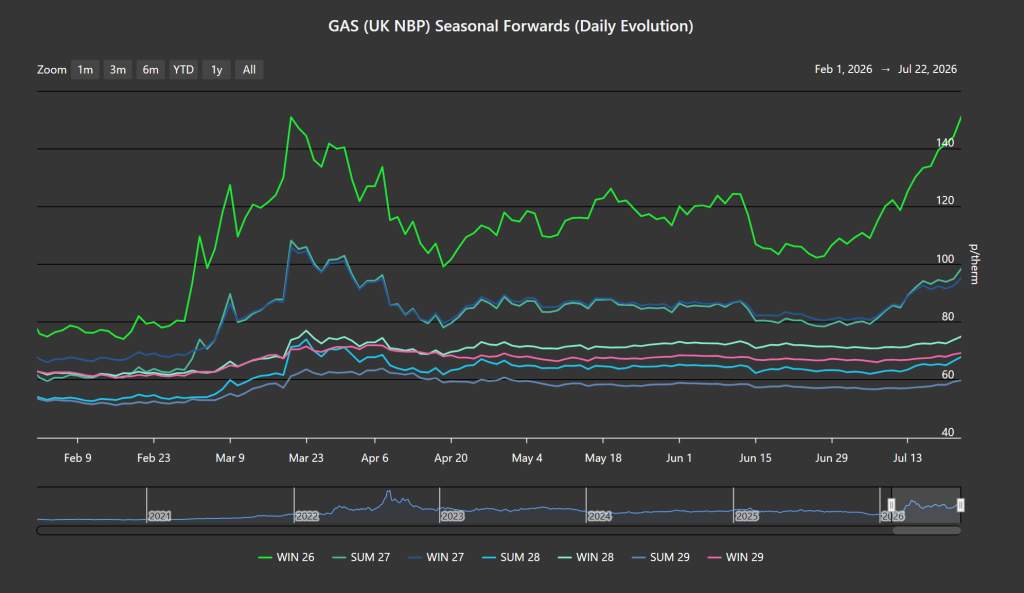
As per the chart below, Winter-26 delivery prices have now risen to parity with the March highs despite weeks of optimism that an agreement to end the war was imminent.
By way of illustrating just how inflated front-end delivery prices have become, at yesterday’s close Dec-26 delivery was at 157p/therm versus Aug-31 delivery at 55p/therm – that’s a discount down the curve of 65%!
Or to put it another way, the top of the curve is at a premium of 285%!
So much for European/UK industry being able to forecast seasonal energy costs with any degree of accuracy.
At the time of writing, rumours of Russia assisting Iran’s missile targeting of US bases, and reports that China’s vessels are still successfully transiting the Red Sea (whilst Saudi Arabia’s are being bombed) can only serve to worsen wider global tensions.
Trump and Saudi Arabia chose yesterday, amid the falling bombs, to announce a landmark nuclear accord which will allow the Gulf kingdom to develop its civilian nuclear programme – supporters of non-proliferation can only look on and shudder.
If Trump has any concerns over his falling domestic approval ratings ahead of the mid-terms in November, he’s not showing it – right now, he’s down to 36%.
All 435 seats for voting members of the House of Representatives and 35 of the 100 Senate seats will be on ballot before Christmas – the Republicans will likely lean in to immigration to bolster support in the face of rising petrol prices and wider inflationary pressures.
From a technical supply perspective, news that Qatar may extend force majeure on LNG cargoes all the way out to mid-October (pending further updates) are adding price support – clearly, Qatar is not confident that exports will resume any time soon.
All eyes are on European storage fullness amid LNG imports declining as global competition for remaining cargoes is rampant – right now, stocks are at 54% versus the 5-year avergae of 67%.
Not surprisingly, for the week ending 17th July, investment funds have once again increased their net long positions on the benchmark TTF exchange by 25%, as they ride the wave of bullish momentum.
Back on 26th June, we issued blanket emails to clients (with near-term open volumes) detailing that markets were in a pronounced dip (against the backdrop of a shaky 60-day ceasefire agreement).
At the time, we thought it prudent that clients thought seriously about closing out not just the front month, but the whole of Q326 whilst the going was good.
Thereafter, over the following days, thankfully the large majority of Q3 Positions were filled.
Looking forward, for clients with Winter-26 open volumes, we’ll look to advise on potential intraday dips and hedging opportunities over the coming days/weeks.
Monthly Day-Ahead Averages for July so far have jumped to 124 p/therm (or 4.23 p/kwh exc. non-gas).
ELECTRICITY & CARBON
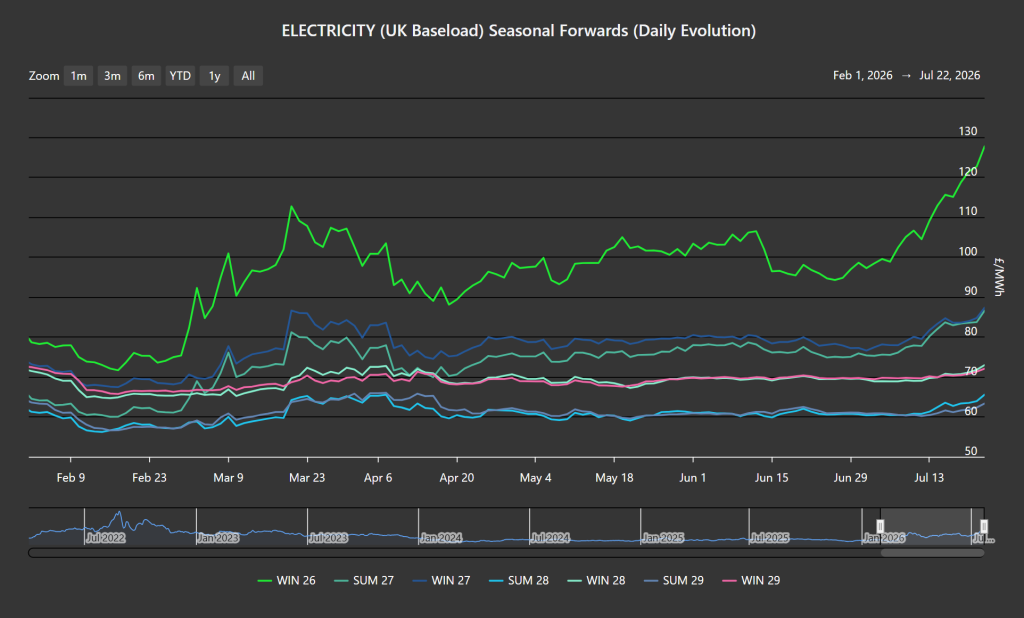
Given the UK’s partial reliance on gas-for-power generation, it makes sense Winter-26 delivery prices are reflecting surging gas prices.
This despite today’s UK electricity generation mix remaining bearish in nature due to strong renewables outputs – specifically, renewables are contributing 40%, thermal at 17% (gas and coal) and low carbon at 25% (nuclear and imports).
As per the chart below, Winter-26 delivery prices have now shot up above the March highs despite weeks of optimism that an agreement to end the war was imminent – however, Summer-27 onwards are little changed, so the pain of the crisis is very much front-loaded.
On the Carbon side of things, mid-price Dec-26 UKA delivery sits at at £61.75/tn (and the spot is at mid 60s) – it would seem likely that emissions prices will start to fall in the face of inevitable industrial demand destruction should gas prices remain at these elevated levels.
For clients with Winter-26 open volumes, we’ll look to advise on potential intraday dips and hedging opportunities over the coming days/weeks.
UK electricity Monthly Day-Ahead Averages for July so far are at £104/mwh (or 10.4 p/kwh exc. non-energy).