Iran and Oman continue to work on an accord over the fate of the Strait of Hormuz.
For its part, the US continues to threaten both Iran and all of its trade partners with further sanctions.
Front-Month delivery dropped by as much as 10% to start the week, amid leaked rumours that deals have been made either between the US and Iran with Pakistan’s help, or between Iran and Oman over the territorial fate of the Strait of Hormuz.
However, prices have since regained some ground after the IRGC (Iran’s Revolutionary Guard) poured cold water on market participants’ premature optimism.
Though an Iranian spokesperson has been keen to point out that Iran and Oman have reached partial agreement on their shares of the territory and revenues (the culmination of several weeks of talks).
So, what happens next (if anything)?
Well, we’d expect for Iran and Oman to reach an agreement soon over the Strait of Hormuz – if, for no other reason, than being able to blame the US for being the only remaining obstruction to the re-opening of the waterway.
From a diplomatic POV, Trump’s increasing isolation will not have gone unmissed by Iran’s negotiators.
Domestic approval of Trump’s war has fallen to its lowest level since the conflict’s early days, and Trump’s popularity amongst voters is likewise at a record low ahead of congressional mid-term elections in November.
For now, the bull-run has stalled – the question on everybody’s lips is “what will Trump do if Iran and Oman reach agreement and open the Strait?”
Will the US somehow blockade transit across the waterway?
Or will Trump be satisfied with turning the economic screw on Tehran with a view to bringing down the regime from within?
Whilst the market meanders in a tight range today, there remains more questions than answers.
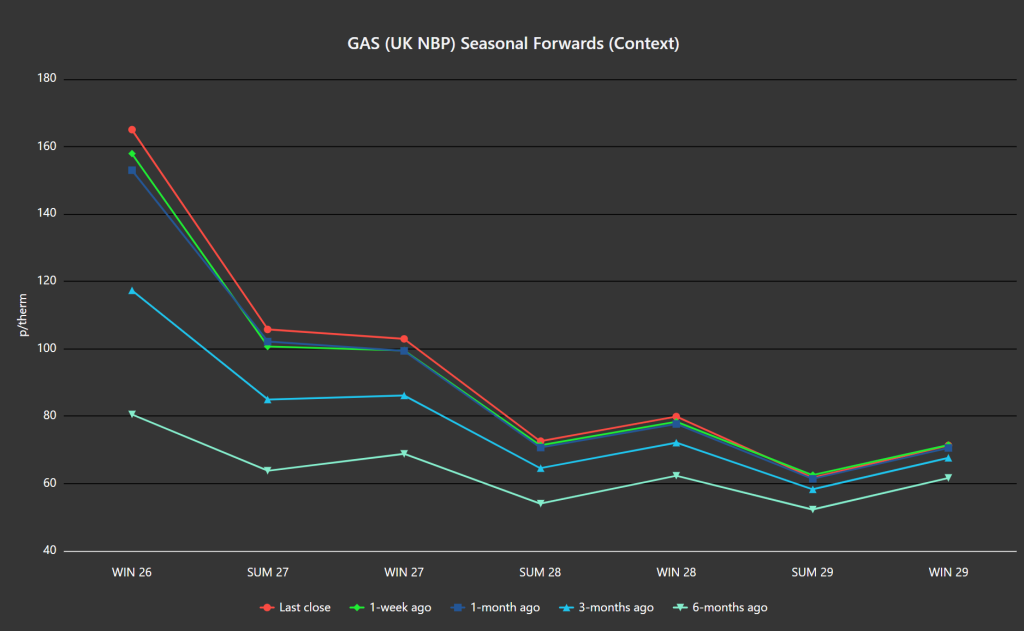
With winter gas contracts trading at more than double last year’s levels, analysts are inevitably focused on the likely impact on inflation, and whether central banks will be forced to hold higher interest rates for longer.
European gas fullness is at 63% versus the 5-year average of 77% – so injections have picked up over the weekend off the back of subdued demand amid falling temperatures.
Looking forward, for clients with Winter-26 open volumes, this next week or so represents the last chance saloon for the re-opening of the Strait of Hormuz.
Whilst we’ll of course look to advise on potential intraday dips and hedging opportunities over the coming days/weeks, time is running out to see significant drops in Winter-26 contracts.
Monthly Day-Ahead Averages for August so far are at 149p/therm (or 5p/kwh exc. non-gas) – the highest level we’ve seen since Jan ’23.
ELECTRICITY & CARBON
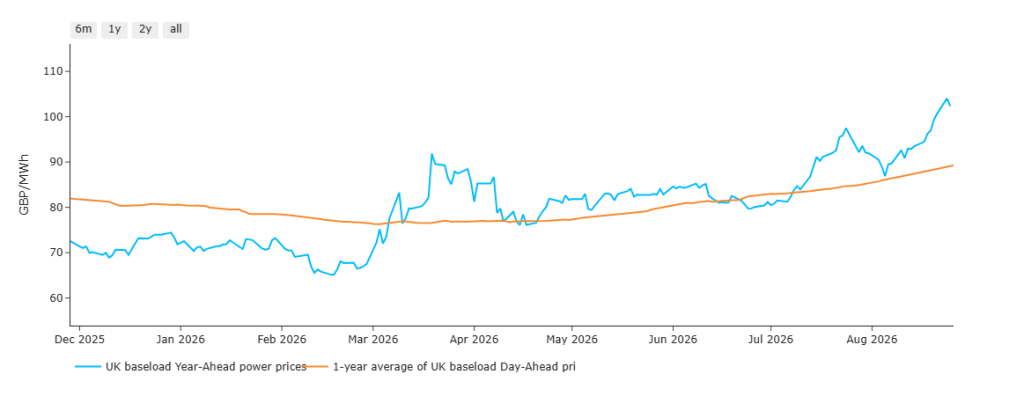
The chart below details UK electricity Year-Ahead prices versus the 1-Year Average of Day-Ahead prices.
By way of explanation, when the blue line is above the orange line, mid-term delivery prices are at a premium to an average of the last 12 months.
As you can see, prior to the onset of the US/Israeli offensive, prices were enjoying a soft-landing heading into Summer-26 – thereafter, Year-Ahead has remained consistently at a premium despite the otherwise ‘summery’ conditions.
For now, near-term delivery remains above averages, and so, pre-war value is still off the table.
Today’s UK electricity generation mix has been bearish in nature due to strong renewables outputs (not that it’s having any bearish effect given the overwhelming impact of looming global gas shortages) – specifically, renewables are contributing 42%, thermal at 16% (gas and coal) and low carbon at 19% (nuclear and imports).
On the Carbon side of things, mid-price Dec-26 UKA delivery sits at at £59.64/tn (and the spot is at early 58s) – price action has become directionless amid surges in near-term gas delivery prices (and the fear of industrial demand destruction).
Looking forward, for clients with Winter-26 open volumes, this next week or so represents the last chance saloon for the re-opening of the Strait of Hormuz.
Whilst we’ll of course look to advise on potential intraday dips and hedging opportunities over the coming days/weeks, time is running out to see significant drops in Winter-26 contracts.
UK electricity Monthly Day-Ahead Averages for August so far are also at £123/mwh (or 12.3p/kwh exc. non-energy).