Without seeking congressional approval, Trump’s Administration assassinated Iran’s leader, and launched a general offensive against Iran back on 28th Feb.
Thereafter, Trump’s Administration has twice agreed ceasefires with Tehran (8th April and 12th June) with a view to walking away from a stalemate.
Not surprisingly, on both occasions, markets dropped significantly and investment funds offloaded their long positions in preparation for the re-opening of the Strait of Hormuz (and the associated resumption of LNG exports from the Gulf to destinations throughout Asia).
Unfortunately, on both occasions, hostilities resumed despite the best efforts of diplomacy and mediation (primarily on the part of Pakistan).
Analysts’ consensus throughout the conflict has been an expectation that Trump would eventually be forced to relent in the face of domestic/global pressure, rising inflation, falling approval ratings, and the impending mid-terms.
Instead, he appears to be doubling-down, consequences be damned.
Despite polls pointing toward the Republicans losing the lower house, and challenging for the upper house come November, Trump has opted to ramp-up economic warfare against Iran, threatening Iran’s trade partners with sanctions if they continue to do business with Tehran.
To clarify, Iran’s primary trade partners are China, UAE, Turkiye, Iraq, Oman, Pakistan, India and Armenia.
As you’d expect, the expansion of the conflict’s impacts to include so many large economies has proven very price supportive over the last couple of days.
And so, market participants and energy consumers across the globe are staring down the barrel of higher prices – indefinitely.
The Strait will remain at a trickle over the coming months, and the global macroeconomic outlook will worsen – inflation will rise, interest rates will need to rise to keep a lid on overheating economies, yields will rise in the face of a global bond sell off (making it more expensive for countries to borrow money), and global economic growth forecasts will be downgraded.
Unless, of course, an agreement can be reached at the 11th hour.
Energy buyers have spent the summer buying near-term delivery in the dips, and hedging further down the curve where prices remain good value.
However, many consumers remain exposed for Winter-26 delivery, which is at nearly 100% premium versus 27th Feb (the day before Trump’s war began) – Winter-26 delivery closed at 80 p/therm on 27th Feb, yesterday closed at 158 p/therm.
The loss of LNG exports through the Strait has inevitably meant that Europe and Asia are competing for the other 80% of global LNG flows – Asia needs to gas to power cooling demand, Europe needs gas to inject into storage for heating season come November.
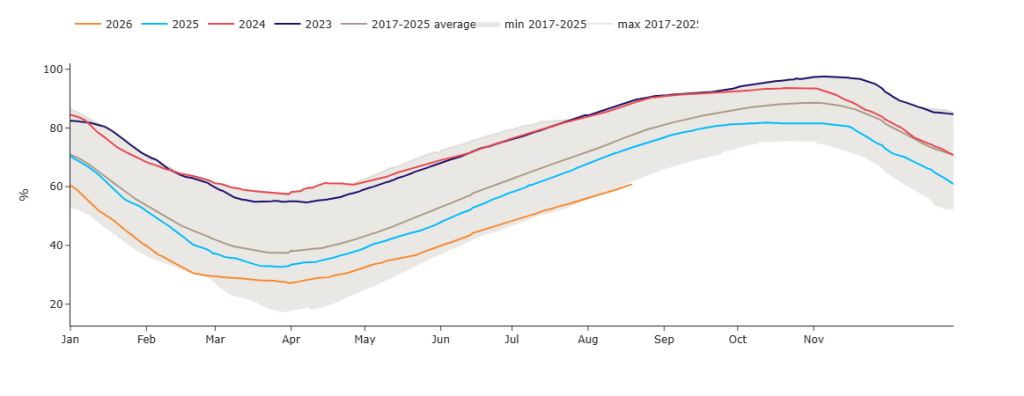
European gas fullness is at 61% versus the 8-year average of 78% – but has now notably fallen out of the 8-year range to the downside giving rise to fears of gas shortages in the event Europe has a cold winter – please see chart below.
Looking forward, for clients with Winter-26 open volumes, we fear the chance to secure pre-war value has all but closed.
Whilst we’ll of course look to advise on potential intraday dips and hedging opportunities over the coming days/weeks, we think it unlikely that any will materialise.
Monthly Day-Ahead Averages for August so far are at 146p/therm (or 5p/kwh exc. non-gas) – the highest level we’ve seen since Jan ’23.
ELECTRICITY & CARBON
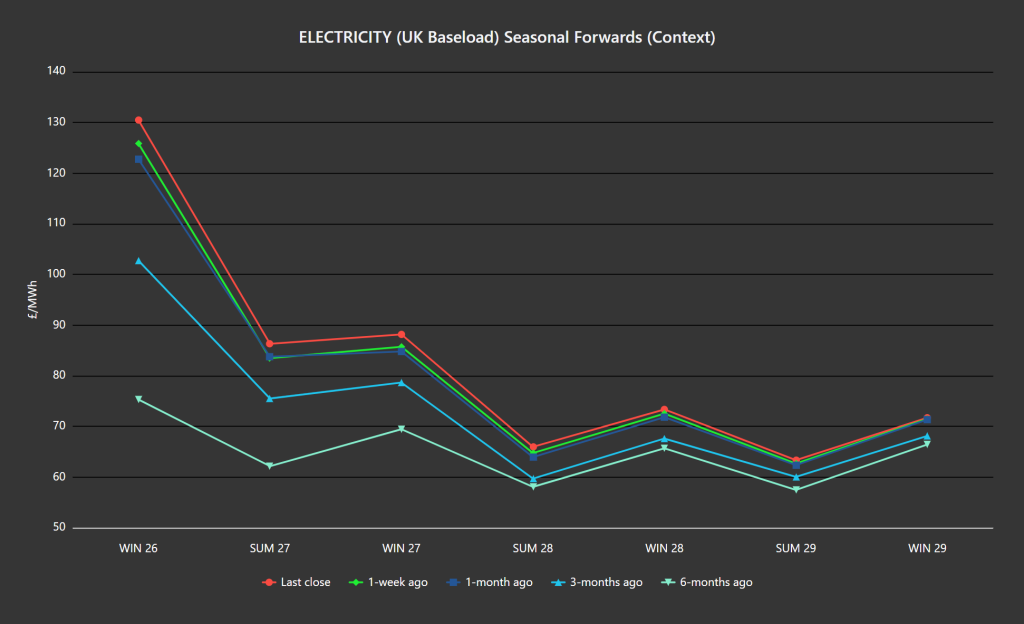
Seasonal Forwards are up versus 1-week, 1-month 3-months, and 6-month ago – please see chart below.
Today’s UK electricity generation mix has been bearish in nature due to strong renewables outputs (not that it’s having any bearish effect given the overwhelming impact of looming global gas shortages) – specifically, renewables are contributing 43%, thermal at 13% (gas and coal) and low carbon at 30% (nuclear and imports).
On the Carbon side of things, mid-price Dec-26 UKA delivery sits at at £59.49/tn (and the spot is at early 58s) – price action has become directionless amid surges in near-term gas delivery prices (and impending industrial demand destruction).
Looking forward, for clients with Winter-26 open volumes, we fear the chance to secure pre-war value has all but closed.
Whilst we’ll of course look to advise on potential intraday dips and hedging opportunities over the coming days/weeks, we think it unlikely that any will materialise.
UK electricity Monthly Day-Ahead Averages for August so far are also at £119.1/mwh (or 11.91p/kwh exc. non-energy).