Iran has spent all week denying Trump’s claims that negotiations are ongoing, choosing instead to clarify that Iran is only in talks with Oman over the future of the Strait of Hormuz, certainly not the US.
The deal between Iran and Oman (who share the Strait of Hormuz along their respective coastlines) is being seen by market participants as a means to end Trump’s ill-conceived war.
Adding insult to injury, the deal if it goes ahead, would give Tehran control over ships entering the Gulf through the Strait of Hormuz, and would mark a glaring concession on the part of the US Administration.
Conspicuously, there has been little or no response from the White House as to the u-turn that the proposed Iran-Oman accord would represent.
Trump has said only that a deal for reopening the Strait is imminent – lest we forget, the US has spent the last 160 days hammering home they would never agree to Iran controlling access to the world’s most important trade route for energy supplies.
Yet, as things stand, an agreement between Iran-Oman looks increasingly likely – and represents a seismic shift in the balance of regional power in Tehran’s favour.
Before the war, the Strait was freely open to all ships with no fees – going forward, fees may become the new norm despite international laws protecting shipping routes from being held to ransom.
Such an outcome is unlikely to mend Trump’s sliding approval ratings in time for the November mid-terms.
Freshly emboldened by Trump’s newfound reticence, Iran has warned Gulf states that any new US attack on its territory would trigger retaliation against critical energy infrastructure across the region.
While addressing supporters at a rally in Las Vegas yesterday, Trump expressed a surprising preference for diplomacy over bombs – “I’d rather make a deal because I don’t want to kill people. I do not want to kill people, but at some point we’re gonna”.
Though, of course, they already have – Iran has reported more than 3,400 deaths since the US/Israeli offensive began on 28th Feb whilst the US has reported 18 military personnel fatalities.
According to a senior Iranian official, Iran is seeking fees of between 5% and 7% of the price of cargoes from ships using the Strait, whilst Oman is putting forward fees of around 3%.
Kazem Gharibabadi, a high-ranking Iranian diplomat, has confirmed that Iran has received messages from the US indicating that it was “fully prepared to return to its commitments” under the mid-June MOU (Memorandum of Understanding) with Iran that provided for “immediate cessation of military operations”.
For his part, Gharibabadi confirmed that yes, this was a pre-condition for reopening of the Strait – again alluding to the fact that increasingly the US are not part of the final negotiation.
Despite early confidence at the start of the offensive that the outcome would be Iran’s “unconditional surrender”, and that he would ultimately approve the choice of Iran’s new leader following the assassination of Ayatollah Ali Khamenei, Trump is having to face up to the realities of domestic pressure to commit to an off-ramp – with US voters now opposing the war two-to-one.
Months of military efforts, a worrying depletion of munitions exascerbated by a two-week orgy of strikes in July, have failed to loosen Iran’s grip on the Strait.
Not surprisingly, benchmark crude oil prices have plunged over the past couple of days, as have near-term delivery gas prices.
In other news, the market remains very sensitive to any developments that could further worsen LNG supply flows, particularly as Europe continues to wrestle with mounting pressure to replenish gas inventories ahead of winter.
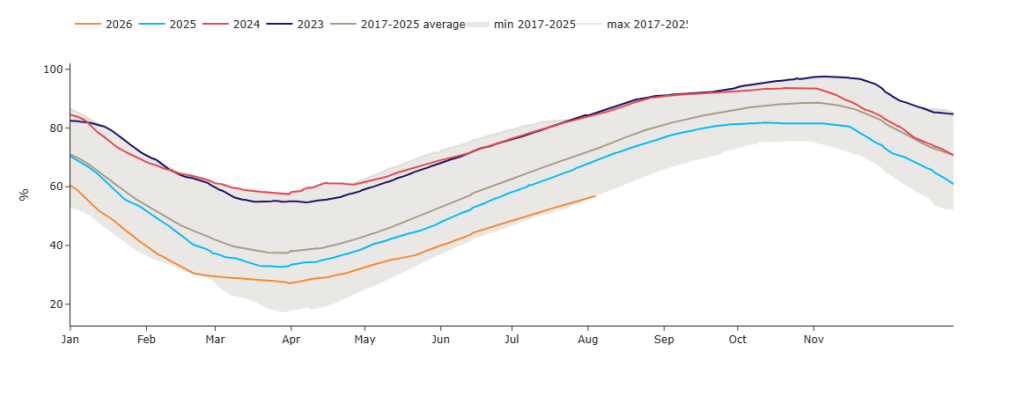
Fullness levels are now at 57% versus the 8-year average of 73% – please see chart below.
Additional price supportive key drivers include supply disruptions to Norwegian flows and UK domestic production due primarily to complications caused by scheduled summer maintenance.
Looking forward, for clients with Winter-26 open volumes, we’ll look to advise on potential intraday dips and hedging opportunities over the coming days/weeks.
Monthly Day-Ahead Averages for July finished at 129 p/therm (or 4.42 p/kwh exc. non-gas).
Monthly Day-Ahead Averages for August so far are at 137p/therm (or 4.67p/kwh exc. non-gas) – the highest level we’ve seen since Dec ’23.
ELECTRICITY & CARBON
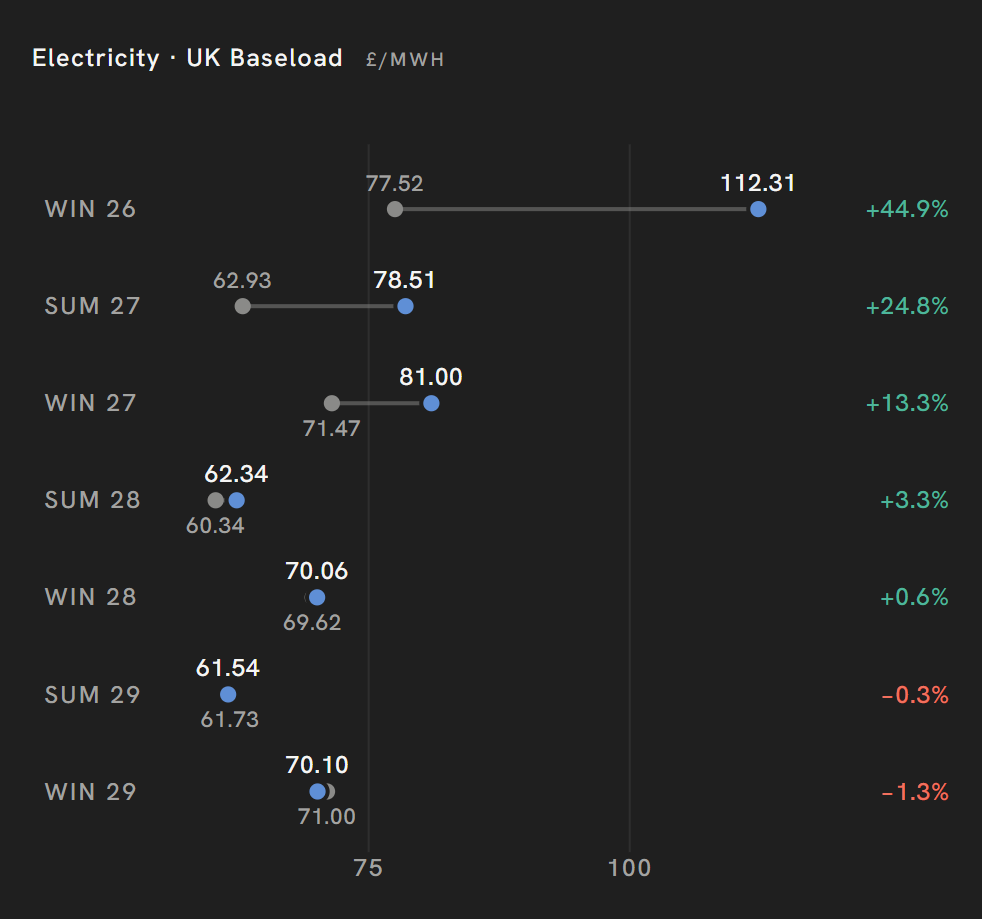
The graphic below is our half-year curve shift – a quick-glance volatility indicator reflecting the percentage changes of the front 7-Seasonal Forward prices versus 6-months ago.
As you can see, the lion’s share of the risk-premium caused by Trump’s war on Iran remains front-loaded.
In fact, when you get right down the curve to Summer-29 and Winter-29, these delivery periods are currently offered at prices lower than 6 months ago (reflecting an underlying sentiment that long-term fundamental drivers remain bearish).
Today’s UK electricity generation mix is bearish in nature due to strong renewables outputs – specifically, renewables are contributing 52%, thermal at 6% (gas and coal) and low carbon at 25% (nuclear and imports).
On the Carbon side of things, mid-price Dec-26 UKA delivery sits at at £59.29/tn (and the spot is at early 58s).
For clients with Winter-26 open electricity volumes, we’ll look to advise on potential intraday dips and hedging opportunities over the coming days/weeks.
UK electricity Monthly Day-Ahead Averages for July finished at £106/mwh (or 10.6 p/kwh exc. non-energy).
UK electricity Monthly Day-Ahead Averages for August so far are also at £106/mwh (or 10.6 p/kwh exc. non-energy).