The US Administration appears to have lost control of the Iran stand-off.
Trump’s response to Iran’s conditions for a peace deal has been to list his own demands that Iran pay compensation for people killed in wars, attacks and protests.
And so, progress in talks between Iran and Oman to re-open the Strait have become irrelevant.
Unless Trump is prepared to lose face, the world’s primary trade waterway will remain closed.
Recent developments have highlighted the Trump Administration’s weaknesses and miscalculations – the assassination of Iran’s 86-year old Supreme Leader, Ayatollah Ali Khameini, at the beginning of the war did in fact result in the IRGC taking a more hardline stance; the MoU signed on 17th Jun was poorly worded, and full of loop holes that Iran has wasted no time in exploiting; the US has grown worryingly low on munitions (a fact that the Administration must have been aware of when they chose to attack Iran back on 28th Feb); Trump’s beligerent Truth Social posts have only served to harden Iran’s stance; after weeks of bombardments, the Iran regime has survived, and has tightened its grip on, not just the Strait of Hormuz, but also the Bal-El-Mandeb Strait in the Red Sea through it’s proxy Houthi militia; and now, when faced with an unwinnable stand-off, Trump’s response has been to dig his heels in, notwithstanding his plummeting domestic approval ratings at home, and the damage being caused to the global economy.
Not surprisingly, benchmark oil prices are back up to $91/barrel – but are still well below the highs of Mar and Apr.
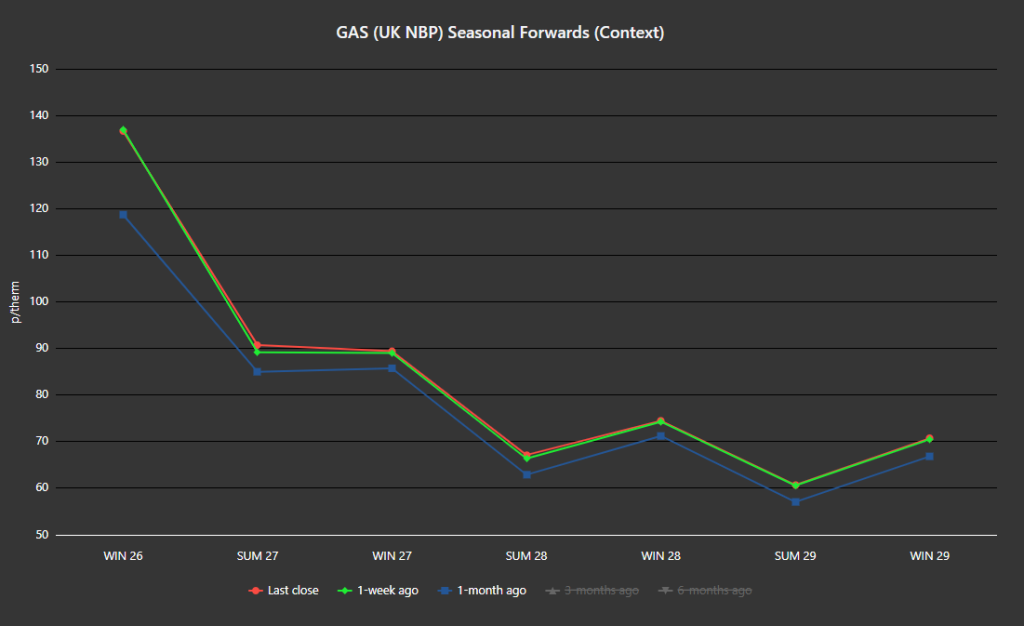
Gas prices are pretty much back to where they were a week ago – please see chart below.
Europe’s gas storage levels remain at their lowest point for this time of year since records began in 2009 – with fullness projected to peak in October at 10-15% below last year’s levels.
So, inventories are now at 59% versus the 5-year average of 72% – but of course 20% of global LNG transit remains closed, the EU still intends to halt Russian LNG imports by ’27, and European/UK production is in decline.
Back in Jan ’26, the outlook was very different – falling prices, and the prospect of a glut of LNG due to the introduction of more and more LNG terminals across the globe in reponse to Russia’s invasion of Ukraine.
Six months on, Trump’s war on Iran has once again shown the frailties of our reliance on fossil fuels to generate electricity and power our industrial output.
Looking forward, for clients with Winter-26 open volumes, we’ll look to advise on potential intraday dips and hedging opportunities over the coming days/weeks – but with only 50 days of the injection season remaining before the onset of Winter-26 delivery, time is running out for the Strait of Hormuz to re-open.
Monthly Day-Ahead Averages for August so far are at 138p/therm (or 4.7p/kwh exc. non-gas) – the highest level we’ve seen since Dec ’23.
ELECTRICITY & CARBON
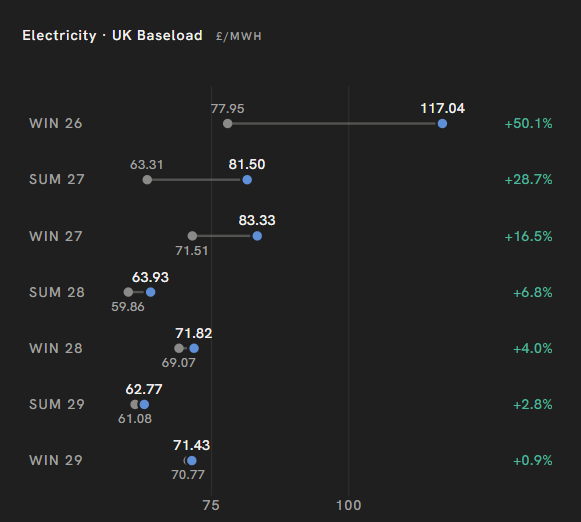
The graphic below is our half-year curve shift – a quick-glance volatility indicator reflecting the percentage changes of the front 7-Seasonal Forward prices versus 6-months ago.
As you can see, the lion’s share of the risk-premium caused by Trump’s war on Iran remains front-loaded.
Today’s UK electricity generation mix is bearish in nature due to strong renewables outputs (not that it’s having any bearish effect given the overwhelming impact of looming global gas shortages) – specifically, renewables are contributing 55%, thermal at 4% (gas and coal) and low carbon at 25% (nuclear and imports).
On the Carbon side of things, mid-price Dec-26 UKA delivery sits at at £59.55/tn (and the spot is at early 58s).
Looking forward, for clients with Winter-26 open volumes, we’ll look to advise on potential intraday dips and hedging opportunities over the coming days/weeks – but with only 50 days of the injection season remaining before the onset of Winter-26 delivery, time is running out for the Strait of Hormuz to re-open.
UK electricity Monthly Day-Ahead Averages for August so far are also at £107/mwh (or 10.7 p/kwh exc. non-energy).