The US paused strikes on Iran on Friday after nearly two weeks of bombardments.
For their part, Iran said it would stop bombing its neighbours in the Gulf if the US stopped bombing Iran.
However, suspected Iranian drone attacks were nonetheless reported in Jordan, Saudi Arabia and northern Iran on Monday of this week, and Jordan reported another drone being downed on Tuesday – so, is Iran taunting Trump just a little bit?
Trump is claiming that the bombs have stopped because diplomacy has resumed – though Tehran say there’s been no progress in talks, and the regime remains indifferent to negotiations with the US.
Instead, Tehran has been in negotitions with its neighbour Oman (with whom it shares opposing coastlines of the Strait of Hormuz) with a view to establishing a shared toll system.
Accordingly, Oman has won backing from Gulf states for a plan that would let Tehran collect ‘voluntary’ fees to use the Strait of Hormuz – though one suspects that if ships don’t pay, they don’t transit!
Washington wants to return to the status quo prior to the war (or so they say), when ships were able to pass freely with no payments, and says charging mandatory fees would be illegal.
But amidst all the claim and counterclaim, rumours abound that the US is running out of munitions (nothwithstanding Trump’s protestations that the US has “far more munitions than anyone in the world, and far more than we need.”)
Notably, the chairman of the Joint Chiefs of Staff, General Dan Caine, has cautioned that “a shortage of air defence interceptors could hamper the ability to protect US forces and allies in the region”.
On top of this, an IPSOS poll released last week reflects the Administration’s fading support across the US, with just one in three Americans now backing the war, and 69% (including four in ten Republicans) conceding that Trump has not “clearly explained the goals of US military involvement in Iran.”
Meanwhile, Trump’s overall approval rating is holding steady (but low) at 37%.
So, is Trump’s war on Iran running out of road at last?
Well, 13 nights of heavy bombardment has failed to hamper Iran’s ability to retaliate – instead, it has only served to deplete the US military’s missile reserves (bearing in mind that missiles take years to manufacture, not months!)
On Thursday, the oil benchmark Brent Crude went to $102/barrel.
That same day, the US stopped dropping bombs, and now oil is down 13% to $89/barrel.
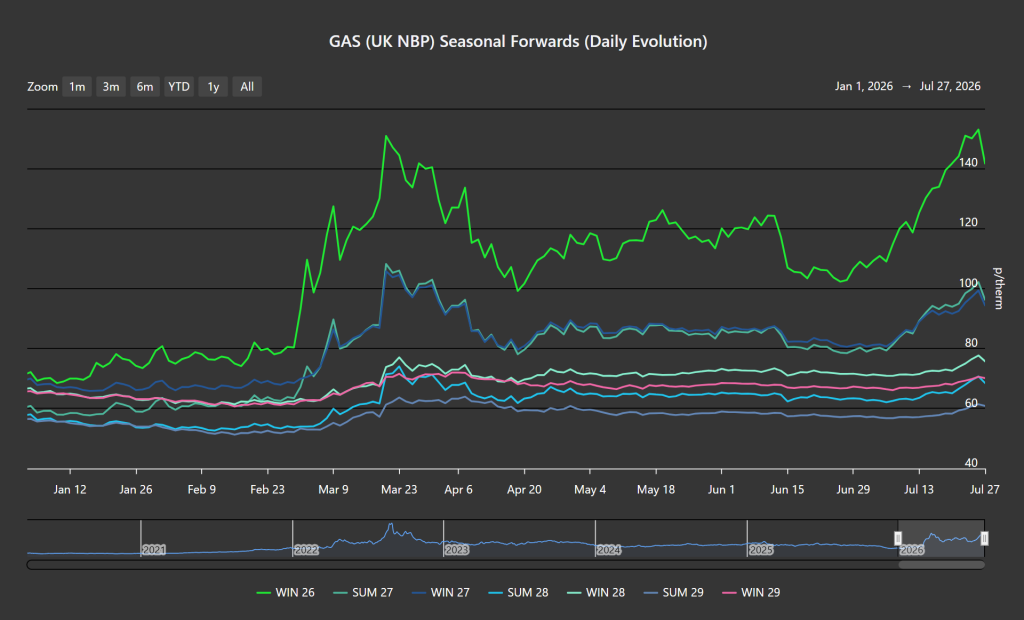
Not surprisingly, front-end delivery European/UK gas prices have also dropped off, amid falling risk-premium and optimism that Trump’s war might be cut short by diminishing resources and domestic pressure.
Back on 26th June, we issued blanket emails to clients (with near-term open volumes) detailing that markets were in a pronounced dip (against the backdrop of a shaky 60-day ceasefire agreement).
At the time, we thought it prudent that clients thought seriously about closing out not just the front month, but the whole of Q326 whilst the going was good.
Thereafter, over the following days, thankfully the large majority of Q3 Positions were filled.
Looking forward, for clients with Winter-26 open volumes, we’ll look to advise on potential intraday dips and hedging opportunities over the coming days/weeks.
Monthly Day-Ahead Averages for July so far remain elevated at 128 p/therm (or 4.23 p/kwh exc. non-gas) following a fortnight of high daily numbers ranging between 124p/therm and 152p/therm.
The chart below details the daily evolution of Seasonal Forwards dating back to the beginning of 2026, clearly showing that whilst the front 2-Seasons went to the moon beginning 28th Feb, the rest of the curve remains only marginally impacted by Trump’s war on Iran.
ELECTRICITY & CARBON
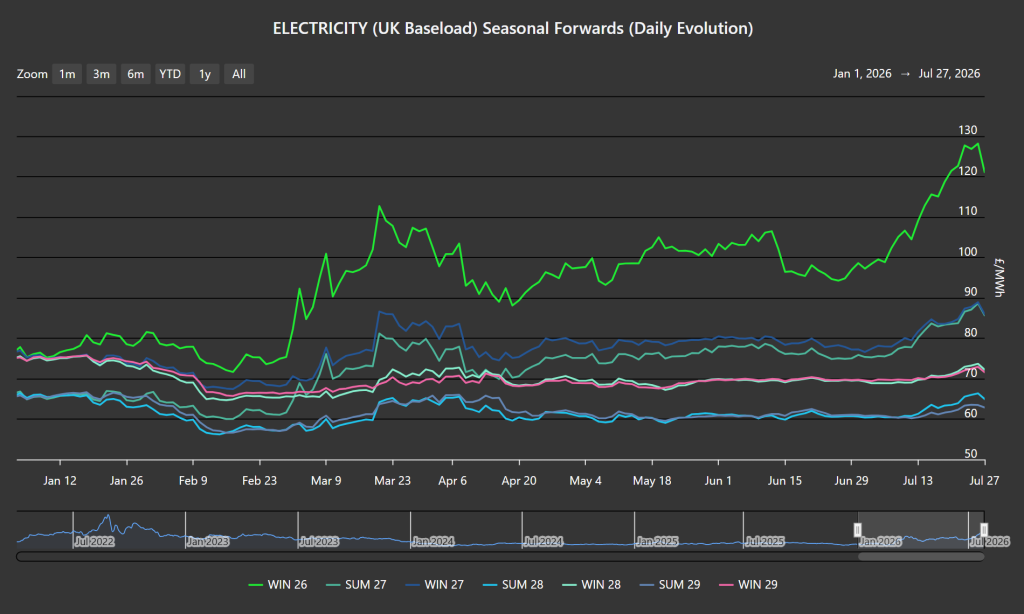
Winter-26 delivery prices are rolling over to mirror this week’s falling gas prices (please see chart below).
Today’s UK electricity generation mix is very bearish in nature due to strong renewables outputs – specifically, renewables are contributing 61%, thermal at 4% (gas and coal) and low carbon at 21% (nuclear and imports).
On the Carbon side of things, mid-price Dec-26 UKA delivery sits at at £59.27/tn (and the spot is at mid 58s).
Last week saw increases in UKAs in-line with gas prices, however it looks as though carbon traders have come to their senses this week, as industrial demand destruction caused by prohibitively high gas prices will inevitably lead to weaker carbon values.
For clients with Winter-26 open electricity volumes, we’ll look to advise on potential intraday dips and hedging opportunities over the coming days/weeks.
UK electricity Monthly Day-Ahead Averages for July so far are at £106/mwh (or 10.6 p/kwh exc. non-energy).